
Quick Answer
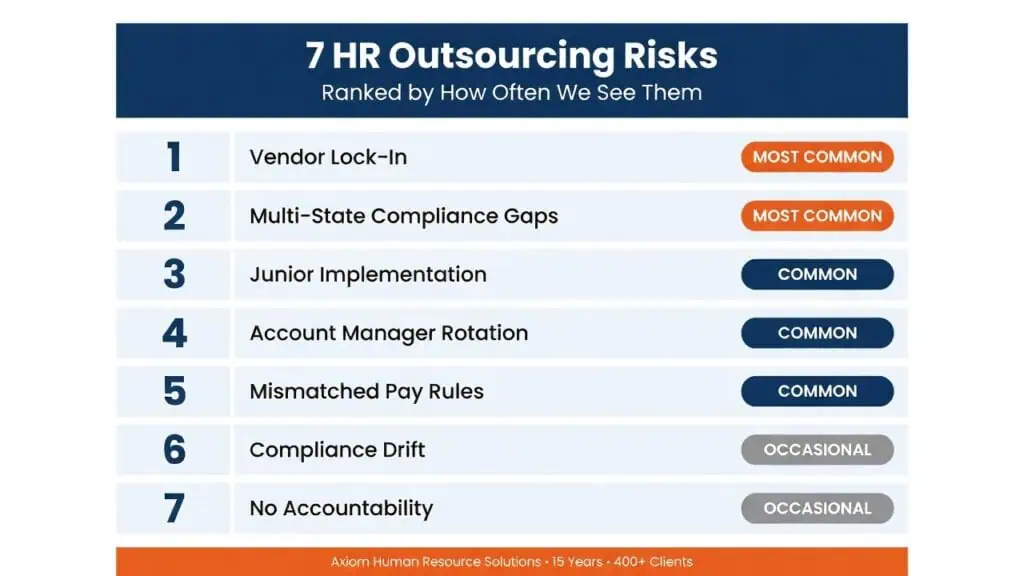
HR outsourcing risks for mid-market companies are real and usually preventable. The seven that actually matter: vendor lock-in via proprietary data formats, hidden multi-state compliance gaps, implementation handoff to junior staff, account manager rotation, software configured wrong for your pay rules, compliance drift after the contract signs, and zero human accountability when paychecks go wrong. Every one of these comes from picking the wrong operator, not from outsourcing itself. Ask the seven questions in this guide before signing any vendor contract.
Table of Contents
- Risk 1: Vendor Lock-In via Proprietary Data Formats
- Risk 2: Hidden Multi-State Compliance Gaps
- Risk 3: Implementation Handoff to Junior Staff
- Risk 4: Account Manager Rotation
- Risk 5: Software Configured Wrong for Your Pay Rules
- Risk 6: Compliance Drift After the Contract Signs
- Risk 7: Zero Human Accountability When Things Break
- The 7 Questions That Catch Every Risk Before You Sign
- Frequently Asked Questions
Why Most HR Outsourcing Risk Lists Get It Wrong
Most HR outsourcing risks are not the ones vendors warn you about on the sales call.
After 15 years in business and 571 client engagements, I have seen the same seven risks show up in mid-market companies that hired the wrong operator. None of these are theoretical. They show up around month four, when the sales team has moved to the next deal and your team is left figuring out who actually owns the configuration that ships every paycheck.
This article walks through all seven. For each one, I will tell you what it looks like in real life, why it happens, and the question to ask before signing a contract to know whether your vendor has it solved.
If you read only one section, read the seven questions at the end. That is the diagnostic that tells you whether the operator you are evaluating is the right one.
Risk 1: Vendor Lock-In via Proprietary Data Formats
Quick Answer: Vendor lock-in in HR outsourcing happens when the provider owns your employee data in a proprietary format and charges fees to export it. The fix is written export terms in the contract before signing.
Vendor lock-in is the oldest play in the payroll software book. Big box providers know that switching costs are the single largest barrier to a client leaving. So they engineer those costs in from day one.
The mechanism is data. Your employee records, pay history, accruals, benefits enrollments, tax filings, and compliance documents all live inside the vendor platform. When you ask to leave, the export comes in a format that requires their tool to read. The export itself comes with a fee. The migration to a new platform takes weeks because the data needs to be transformed.
By the time you finish that math, staying with a vendor you do not like starts looking cheaper than leaving.
The right operator writes export terms into the contract before you sign. Standard CSV format. Defined data fields. No export fee. Documented data ownership. If a vendor cannot put any of those terms in writing, the lock-in risk is real.
What to ask before signing: What format does our data export in, who owns it, and what does it cost to export at any time during or after the contract?
Risk 2: Hidden Multi-State Compliance Gaps
Quick Answer: HR outsourcing vendors typically handle federal payroll taxes well but punt state-level registration, certified payroll, and ACA reporting back to your team after the sale. Get a written compliance scope before signing.
Mid-market companies often grow into multi-state employment without realizing what changes underneath the payroll system. One remote hire in Pennsylvania. One warehouse in Tennessee. One short construction project in Ohio. Each one changes the compliance picture.
Most HR outsourcing vendors handle federal payroll taxes well. The friction shows up at the state level. State unemployment registration. State income tax filing. Certified payroll reporting for prevailing wage projects. ACA 1095-C generation. Workers comp reporting. These often get punted back to the client after the sale, with surprise fees attached when something is missed.
The right operator writes a compliance scope into the contract. Every state you operate in. Every filing the vendor owns. Every filing that remains your responsibility. Every fee for additional state registrations as you grow.
If the proposal does not have a section called Compliance Scope with specific items listed, your risk is real. The U.S. Department of Labor publishes the federal baseline. Every state adds its own layer on top.
What to ask before signing: Which compliance items does your team own, which remain ours, and what is the fee structure for adding new state registrations?
Risk 3: Implementation Handoff to Junior Staff
Quick Answer: Most failed HR outsourcing implementations come from senior salespeople selling deals and junior configurators building them. Ask to meet the actual implementation team before signing and get their tenure in writing.
This is the most expensive risk on the list and the easiest one to spot in advance.
Big box providers run on volume. The salesperson who walks you through the pitch has been with the company for years and knows the platform inside out. That same person disappears once the contract signs. The implementation gets handed to whoever has bandwidth. Frequently that is somebody who has been on the platform for less than a year and has never configured a multi-state employer with union overtime rules.
The result is an implementation that takes three times longer than promised, ships with errors that surface in the first pay cycle, and creates a backlog of fixes that your team owns even though you paid for the vendor to handle it.
The right operator names the implementation lead in the proposal. Includes their tenure. Confirms they personally own the configuration. As a UKG Ready Preferred Partner, Axiom puts the implementation lead in the room with you on the first scoping call. The person who builds it is the person who scopes it.
What to ask before signing: Who configures the platform, what is their tenure on this product, and will you put their name in the contract?
Risk 4: Account Manager Rotation
Quick Answer: Account manager rotation in HR outsourcing is when your assigned vendor contact changes every 12 to 24 months. Each rotation forces your team to retrain a new person on your pay rules. Ask for written AM tenure data before signing.
Account manager turnover is the slow tax on outsourcing. It rarely causes one big problem. It causes a thousand small ones over five years.
The pattern is consistent. You sign with a vendor. You spend the first six months teaching your assigned AM about your business, your pay rules, your seasonal schedules, your union contracts, your union dues remittance, your benefit deduction rules, your custom GL mapping. Around month 18, that AM gets promoted or leaves. The new AM has none of that context. You spend the next six months teaching them.
In between those teaching cycles, mistakes happen. The new AM does not know that your warehouse pays time and a half after 40 but your delivery drivers pay it after 8 in a day. They process a normal cycle and your drivers are short. You catch it in the next reconciliation, but two paychecks went out wrong.
Boutique operators have lower AM turnover because the work environment is more stable and the relationships are deeper. The right operator gives you AM tenure data in writing. If the average tenure is under 24 months, the risk is real.
What to ask before signing: What is your average account manager tenure in years, and what is your retention rate at the 24-month mark?
Risk 5: Software Configured Wrong for Your Pay Rules
Quick Answer: HR outsourcing software configured out-of-the-box typically ignores overtime rules, union contracts, certified payroll requirements, and shift differentials. Get configuration confirmed in writing for every pay rule unique to your business.
Out-of-the-box payroll is built for the simple case. One pay rate, one overtime rule, one schedule, one location.
Mid-market employers are rarely the simple case. Healthcare has differentials for night shifts, weekends, and holidays. Manufacturing has union contracts with double-time after 12 hours. Construction has prevailing wage projects, certified payroll requirements, and per diem rules. Skilled trades have apprenticeship rates that step up at defined hours.
When the vendor does not configure these correctly during implementation, every pay cycle ships with errors. The reconciliation happens after the fact. Your team eats the time. The vendor charges for off-cycle corrections.
The right operator walks every pay rule with you during scoping. Documents the configuration. Tests it in parallel before going live. Confirms it in writing before the first real cycle. SHRM guidance on HR vendor selection calls this scoping discipline the single biggest predictor of implementation success.
What to ask before signing: Will you document every pay rule unique to our business in the implementation scope and run a parallel test cycle before going live?
Risk 6: Compliance Drift After the Contract Signs
Quick Answer: Compliance drift in HR outsourcing happens when the vendor stops tracking law changes for your state or industry after the contract signs. Verify ongoing compliance updates are part of the service before signing.
This risk is the slowest one to surface and the most expensive when it does.
When the contract signs, the vendor regulatory team has the latest information. Six months later, your state changes its meal break rules. Twelve months later, your state changes its overtime calculation for healthcare workers. Eighteen months later, the federal Department of Labor updates the salary threshold for exempt status.
If the vendor product team is focused on selling the next big client instead of updating compliance for existing clients, those changes do not get reflected in your configuration. You ship payroll with old rules. The penalty shows up six to twelve months after the violation, in the form of back wages owed and DOL penalties paid.
The right operator has a documented compliance update process. Quarterly review of state-specific rules. Industry-specific updates for healthcare, manufacturing, and construction. Written confirmation when rules change.
What to ask before signing: What is your process for tracking and applying state-level and industry-level compliance updates after the contract signs?
Risk 7: Zero Human Accountability When Things Break
Quick Answer: When an HR outsourcing platform makes a payroll error, “the platform handled that” is not an acceptable answer. Verify human ownership of mistakes before signing.
Software is good at doing what it is told. Software is not good at owning the consequence when what it was told turns out to be wrong.
When a paycheck ships incorrectly, somebody needs to own the fix. Catching it. Explaining it to the employee. Processing the correction. Filing the amended tax forms. Updating the configuration so the same error does not happen again.
Big box providers often hide behind their platform. “The system processed what was in the file.” That answer leaves your team holding the bag while the vendor declines accountability.
The right operator owns it. Same phone number, same person, same response time, regardless of whether the error was in the configuration, the file, or the system itself. Backed by humans who actually pick up the phone is not a tagline at Axiom. It is the actual product.
What to ask before signing: When a paycheck is wrong, who owns the fix, what is the resolution timeline, and what is included in the price?
The 7 Questions That Catch Every Risk Before You Sign
-
- What format does our data export in, who owns it, and what does it cost to export?
- Which compliance items does your team own, which remain ours, and what is the fee structure for new state registrations?
- Who configures the platform, what is their tenure, and will you put their name in the contract?
- What is your average account manager tenure in years, and what is your retention rate at 24 months?
- Will you document every pay rule unique to our business and run a parallel test cycle before going live?
- What is your process for tracking and applying state-level and industry-level compliance updates after the contract signs?
- When a paycheck is wrong, who owns the fix, what is the resolution timeline, and what is included in the price?
If a vendor cannot answer all seven in writing, the risk is real. If they can, you have the right operator.
“Every one of the seven risks I see in HR outsourcing comes from picking the wrong operator, not from outsourcing itself. The platform is the delivery mechanism. The operator is the actual product.”
— Andy Zelt, CEO and Founder, Axiom Human Resource Solutions
Frequently Asked Questions
What are the biggest risks of outsourcing HR for mid-market companies?
The 7 most common HR outsourcing risks for mid-market companies are vendor lock-in via proprietary data formats, hidden compliance gaps in multi-state employment, implementation handoff to junior staff after the sale, account manager rotation, software configured wrong for your pay rules, compliance drift once the contract is signed, and zero human accountability when paychecks go wrong.
Is HR outsourcing risky for compliance?
HR outsourcing can be risky for compliance when the vendor handles federal items well but punts state-level registration, certified payroll, ACA reporting, or industry-specific filings back to your team after the sale. Ask every vendor for written confirmation of which compliance items they own and which remain your responsibility.
How do I know if my HR outsourcing provider is using junior staff for implementation?
Ask to meet the actual implementation team before signing, not just the salesperson. Get names and tenure. Confirm in writing that the implementation lead with at least 5 years of experience will own the configuration. The most expensive HR outsourcing mistake is a senior salesperson handing the project to a junior implementer once the contract is signed.
What is account manager rotation in HR outsourcing?
Account manager rotation is when your assigned vendor point of contact changes every 12 to 24 months. Each rotation forces your team to re-explain your pay rules, business operations, and configuration history. Lost institutional knowledge causes payroll errors, compliance gaps, and slower issue resolution. Ask vendors for written average account manager tenure before signing.
How can I avoid vendor lock-in with HR outsourcing?
Avoid HR outsourcing vendor lock-in by confirming in writing that you own your employee data, can export it in standard formats at any time, and will not be charged data extraction fees. Get the export specification documented before signing. If a vendor cannot give you that in writing, the lock-in risk is real.
What is compliance drift in HR outsourcing?
Compliance drift is when an HR outsourcing vendor stops updating regulatory knowledge for your state or industry after the contract signs. The salesperson knew the rules at signing. The product team is focused on the next sale. Twelve months in, your configuration is running on outdated state law and you do not find out until a penalty hits.
What questions should I ask before signing an HR outsourcing contract?
Ask: who actually configures the platform and what is their tenure, how is multi-state compliance handled, what data can I export and at what cost, what is the average account manager tenure, what happens when a paycheck is wrong, and what fees are not in the base monthly price. Get every answer in writing before signing.
Is HR outsourcing safer than keeping HR in-house?
HR outsourcing is safer than in-house HR when you pick the right operator. The risks come from picking the wrong vendor, not from outsourcing itself. A right-sized boutique provider with senior implementation and stable account management almost always reduces compliance risk compared to a single in-house HR person juggling payroll, benefits, and regulations.
Ready to evaluate your current HR vendor against these 7 questions?
Related Reading
About Andy Zelt
Andy Zelt is the CEO and Founder of Axiom Human Resource Solutions. With nearly 25 years of experience in HR, payroll, and HCM technology, Andy has helped hundreds of mid-market businesses get off broken payroll systems and onto platforms that actually work. He founded Axiom in 2011 with one goal: give growing companies the same quality of HR and payroll support that enterprise companies take for granted, backed by humans who actually pick up the phone.
About Axiom Human Resource Solutions
Axiom Human Resource Solutions is a boutique UKG Ready Preferred Partner and Authorized Reseller based in Indianapolis, Indiana. We specialize in white-glove HCM implementation, payroll compliance, and ongoing human-backed support for employers with 50 to 500 employees in healthcare, manufacturing, construction, and skilled trades. We help you WIN with technology, backed by humans who care.