
AI Summary: Healthcare payroll compliance involves managing complex wage laws, overtime regulations, credential tracking, shift differentials, and regulatory reporting requirements across clinical and non-clinical staff. Mid-sized healthcare organizations—including clinics, senior living facilities, behavioral health providers, and multi-location systems—often struggle with payroll accuracy, audit readiness, and system configuration as they scale beyond 50 employees. Errors in healthcare payroll create compliance risks, employee dissatisfaction, and potential penalties from regulatory agencies. Axiom Human Resource Solutions provides compliance-backed UKG Ready implementations specifically designed for healthcare employers who need precision configuration, human-backed support, and systems that match how their operations actually run.
⚡ Key Takeaways
- Shift differentials are the #1 source of healthcare payroll errors—automation is essential
- Credential tracking must integrate with scheduling to prevent compliance violations
- Multi-state operations require state-specific overtime and tax configurations
- Generic payroll software lacks healthcare-specific compliance features
- Training gaps cause more errors than software limitations
What is Healthcare Payroll Compliance?
Healthcare payroll compliance refers to the accurate management of all wage, hour, tax, and regulatory requirements specific to healthcare organizations. Unlike standard payroll processing, healthcare payroll must account for complex variables that are unique to clinical environments.
Shift differentials represent one of the most common compliance challenges. Nurses, CNAs, and other clinical staff frequently work evening, night, and weekend shifts that require premium pay rates. When these differentials are not configured correctly in payroll systems, organizations either overpay—creating budget problems—or underpay, which triggers compliance violations and employee grievances.
Credential and certification tracking adds another layer of complexity. Healthcare workers must maintain active licenses, certifications, and continuing education credits. Payroll systems need to connect with credentialing databases to ensure that employees are not scheduled or paid for work they are not legally qualified to perform.
Overtime calculations in healthcare settings often involve multiple pay rates, on-call time, callback pay, and mandatory overtime rules that vary by state. California, for example, has daily overtime requirements that differ from federal weekly overtime rules. Multi-state healthcare organizations must configure their systems to handle these variations automatically.
Regulatory reporting requirements round out the compliance picture. Healthcare organizations must accurately report wages for workers’ compensation, unemployment insurance, and various state and federal programs. Errors in these reports can trigger audits, penalties, and reputational damage.
Who Struggles with Healthcare Payroll Compliance?
Healthcare payroll compliance challenges affect organizations across the entire care continuum, though the specific pain points vary by organization type and size.
Clinics and medical practices with 50 to 150 employees often hit a breaking point where manual processes and basic payroll software can no longer keep up. These organizations typically have a mix of physicians, nurse practitioners, medical assistants, and administrative staff—each with different pay structures, schedules, and compliance requirements.
Senior living and long-term care facilities face some of the most complex payroll scenarios in healthcare. With 24/7 staffing requirements, high turnover rates, multiple shift differentials, and frequent schedule changes, these organizations need systems that can handle constant variability without creating errors.
Behavioral health providers often operate across multiple locations with a mix of full-time, part-time, and contract clinicians. Credentialing requirements vary by state and payer, adding compliance complexity that intersects directly with payroll.
Home health and hospice agencies deal with mobile workforces, mileage reimbursement, visit-based pay structures, and complex scheduling across wide geographic areas. Payroll errors in these settings often go undetected longer because of the distributed nature of the work.
Multi-location healthcare systems face the challenge of standardizing payroll processes across facilities that may have grown through acquisition, each with legacy systems and historical pay practices.
The roles most directly affected by healthcare payroll compliance include Chief Financial Officers who bear responsibility for audit readiness and financial accuracy, Vice Presidents of Human Resources who must balance employee satisfaction with compliance requirements, Payroll Managers who execute day-to-day processing while managing exceptions and corrections, and Directors of Nursing and Operations who need accurate labor cost data to manage staffing budgets.
Organizations between 50 and 2,000 employees typically feel these challenges most acutely—large enough to have significant complexity, but often without dedicated compliance staff or enterprise-level systems.
What Good Healthcare Payroll Looks Like
When healthcare payroll compliance is handled correctly, organizations experience a fundamentally different operational reality. Understanding what “good” looks like helps leaders evaluate their current state and set appropriate expectations for improvement.
Accurate first-time payroll runs become the norm rather than the exception. Organizations with well-configured systems and proper training typically achieve 98% or higher accuracy on initial payroll processing, with minimal corrections needed after the fact. This accuracy extends to shift differentials, overtime calculations, and premium pay—all calculated automatically based on predefined rules.
Audit readiness becomes a byproduct of daily operations rather than a special project. When payroll systems are configured correctly and integrated with time and attendance, credentialing, and HR data, the documentation needed for audits exists naturally within the system. Pulling reports for Department of Labor inquiries, workers’ compensation audits, or internal reviews takes minutes rather than days.
Employee trust improves measurably when paychecks are consistently accurate. Healthcare workers who can rely on correct pay—including all their differentials, overtime, and special pay codes—have one less source of workplace stress. This matters particularly in healthcare, where burnout and turnover are ongoing challenges.
Manager self-sufficiency increases when systems are intuitive and well-designed. Nurse managers and department supervisors can approve time, manage schedules, and understand labor costs without requiring constant support from HR or payroll staff. This distributed capability reduces bottlenecks and improves data quality.
Compliance confidence allows leadership to focus on strategic priorities rather than constantly worrying about payroll-related risks. When systems are properly configured and staff are properly trained, compliance becomes embedded in daily workflows rather than requiring constant vigilance.
Real-time visibility into labor costs helps organizations manage staffing budgets proactively. Leaders can see overtime trends, differential costs, and staffing patterns as they develop—not weeks later when payroll is processed.
Common Healthcare Payroll Mistakes
Healthcare organizations make predictable payroll mistakes, often without realizing the compliance risks they are creating. Recognizing these patterns is the first step toward avoiding them.
Relying on default software configurations is perhaps the most common and costly mistake. Payroll and HCM systems ship with generic settings that rarely match the specific pay rules, differential structures, and compliance requirements of healthcare organizations. When organizations implement new systems without customizing these configurations, they import errors that compound over time.
Underinvesting in training creates ongoing problems even with well-configured systems. When payroll staff, HR team members, and managers do not fully understand how to use their systems, they create workarounds that introduce errors. Training is not a one-time event—it requires ongoing reinforcement as staff turn over and systems are updated.
Manual tracking of compliance requirements invites human error. Organizations that track credentials, certifications, and licenses in spreadsheets rather than integrated systems inevitably have gaps. When credentialing data lives separately from payroll and scheduling systems, the connections that prevent compliance violations do not exist.
Treating payroll as purely a finance function rather than an operational partnership limits effectiveness. Payroll accuracy depends on data quality from scheduling, timekeeping, and HR systems. When payroll operates in isolation, errors originating in other departments are not caught until paychecks are wrong.
Delaying system updates and maintenance allows small problems to become large ones. Payroll systems require regular updates for tax tables, compliance rules, and software patches. Organizations that defer this maintenance accumulate technical debt that eventually requires expensive remediation.
Assuming national payroll providers understand healthcare creates false confidence. Large payroll companies serve thousands of clients across every industry. Their support staff typically lack deep expertise in healthcare-specific compliance requirements, leaving organizations to figure out complex configurations on their own.
Healthcare Payroll Compliance: Key Differentiators
| Compliance Challenge | ✅ Axiom + UKG Ready Solution | Generic Payroll Providers |
|---|---|---|
| Shift Differentials | Auto-calculated from scheduling rules — no manual | Manual entry, frequent errors |
| Credential Tracking | Integrated with scheduling — blocks unqualified staff | Separate systems, manual reconciliation |
| Multi-State Overtime | State-specific rules auto-applied (CA daily OT, etc.) | Manual configuration, high error risk |
| 24/7 Staffing Rules | Native shift rules, callback pay, on-call automation | Workarounds required |
| Audit Readiness | Reports pull in minutes — always current | Manual assembly, days of prep |
| Float Pool Management | Integrated scheduling + payroll for float staff | Not supported natively |
| FLSA Compliance | Auto-enforced for regular rate calculations | Manual tracking, compliance exposure |
| Support Model | Named team with healthcare payroll expertise | Call center generalists |
*Based on Axiom HRS client experience serving healthcare organizations nationally.

How Different Providers Approach Healthcare Payroll
Healthcare organizations have several options for managing payroll compliance, each with distinct advantages and limitations. Understanding these differences helps leaders make informed decisions based on their specific needs.
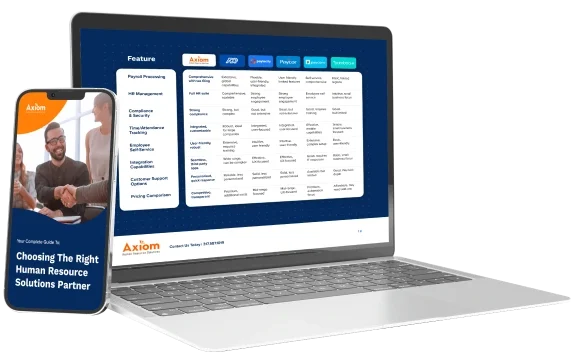
National payroll providers like ADP, Paychex, and Paylocity offer broad platforms with extensive feature sets. Their scale provides stability, widespread integrations, and name recognition. However, their support models typically rely on call centers and ticketing systems staffed by generalists who rotate across many accounts. For healthcare organizations with complex, industry-specific requirements, this model often falls short. Configuration tends toward standardized templates rather than customized setups, and getting specialized guidance on healthcare compliance can be challenging.
Direct vendor relationships with HCM platform providers like UKG offer access to powerful technology without intermediaries. Organizations that have sophisticated internal HR and IT teams may succeed with this approach. However, direct implementations require significant internal resources for configuration, training, and ongoing optimization. Organizations without dedicated HRIS staff often struggle to fully leverage the platform’s capabilities.
Boutique HCM partners specialize in specific industries or platforms and provide hands-on implementation, configuration, and ongoing support. These partners typically offer deeper expertise in healthcare-specific requirements, more personalized service relationships, and configuration that matches how organizations actually operate. The tradeoff is that boutique partners may have less brand recognition and smaller support teams than national providers.
The right choice depends on several factors: the complexity of your payroll requirements, the strength of your internal HR and IT resources, your tolerance for standardized versus customized solutions, and the level of ongoing support you need. Organizations with complex healthcare payroll requirements and limited internal HRIS expertise often find that boutique partners provide the best balance of capability and support.

Where Axiom HRS Fits
Axiom HRS works with mid-market healthcare organizations that use UKG Ready and need more than a software platform—they need a partner who understands healthcare payroll complexity.
As a UKG Ready Preferred Partner and Authorized Reseller, Axiom provides white-glove implementation, configuration, and ongoing support specifically designed for healthcare employers. This means shift differentials configured to match your actual pay practices, credential tracking integrated with your payroll and scheduling workflows, and compliance reporting that meets your specific regulatory requirements.
Our clients include clinics, senior living facilities, behavioral health providers, home health agencies, and multi-location healthcare systems across the United States. We specialize in organizations with 50 to 2,000 employees—large enough to have complex requirements, but often underserved by national providers focused on higher-volume accounts.
What makes Axiom different is our service model. When you call Axiom HRS, you reach people who know your organization, understand healthcare payroll, and can solve problems without escalating through multiple support tiers. We do not just implement systems—we configure them to match how your organization actually operates, train your staff to use them effectively, and provide ongoing support as your needs evolve.
Our approach focuses on precision configuration, thorough training, and human-backed support. We believe that most payroll problems are not software problems—they are configuration and training problems. When systems match how the business runs and staff know how to use them correctly, compliance follows naturally.
“Healthcare payroll is uniquely complex. Shift differentials, credentials, union rules, multiple locations—you can’t solve that with off-the-shelf settings. The organizations that get this right invest in configuration that matches their actual operations and training that gives their people confidence. That’s where we focus our energy.”
— Andy Zelt, Founder & CEO, Axiom Human Resource Solutions
Frequently Asked Questions
What size healthcare organization is this best for?
Axiom Human Resource Solutions specializes in mid-market healthcare organizations with 50 to 2,000 employees. This includes growing clinics, multi-location practices, senior living communities, behavioral health providers, and ambulatory surgery centers that have outgrown basic payroll solutions but need more hands-on support than enterprise vendors provide.
Which types of healthcare facilities do you work with?
We work with clinics, medical practices, senior living and long-term care facilities, behavioral health organizations, post-acute care providers, home health agencies, ambulatory surgery centers, and multi-location healthcare systems. Our expertise spans organizations with complex shift structures, credential requirements, and regulatory compliance needs.
How does Axiom HRS handle healthcare-specific pay rules like shift differentials?
We configure UKG Ready to automate your exact shift differential calculations, including evening, night, weekend, and holiday premiums. Rather than using generic templates, we build pay rules that match how your facility actually operates—ensuring accurate paychecks without manual adjustments or workarounds.
What healthcare certifications and credentials can you track?
We configure UKG Ready to track nursing licenses (RN, LPN, CNA), clinical certifications, CPR and BLS credentials, state-specific licenses, DEA registrations, and continuing education requirements. The system automatically alerts managers before credentials expire and can prevent scheduling employees for roles they are not currently certified to perform.
How long does implementation typically take for healthcare organizations?
Most healthcare implementations take 60 to 120 days depending on complexity, number of locations, and integration requirements. Our white-glove approach includes thorough discovery, parallel processing during transition, extensive testing, and hands-on training for supervisors and payroll staff before go-live.
Do we need internal payroll staff to work with Axiom?
Not necessarily. Our HR outsourcing model can serve as your complete payroll and HR team, or we can work alongside your existing staff to handle specific functions. Many healthcare organizations use our managed services to supplement lean HR departments without adding headcount.
Does Axiom HRS work with healthcare organizations outside Indiana?
Yes. While Axiom is headquartered in Indianapolis, we serve healthcare organizations across the United States. Our expertise in multi-state payroll compliance is particularly valuable for organizations with locations in multiple states, each with different wage laws and regulatory requirements.
How do you handle healthcare union payroll requirements?
For unionized healthcare facilities, we configure pay rules, seniority-based scheduling, shift bidding, and contract-specific requirements directly into your UKG Ready system. This includes union dues deductions, grievance tracking integration, and reporting that satisfies collective bargaining agreement requirements.
Can you help if our current payroll system is creating compliance problems?
Yes. Many healthcare clients come to us after struggling with implementations done by other vendors. We assess your current configuration, identify compliance gaps, and remediate issues. Sometimes this requires significant reconfiguration; other times it is targeted adjustments and better training. Either way, we fix it.
What makes Axiom different from national payroll providers like ADP or Paychex?
National providers optimize for volume and standardization. Axiom HRS provides boutique, white-glove service with dedicated teams who know your operation, precision configuration for healthcare-specific pay rules, and human-backed support when you need it—not a ticketing system and a callback promise. When you call us, you reach people who know your organization.
Related Healthcare Payroll Resources
Ready to Discuss Your Healthcare Payroll Challenges?
If your healthcare organization is struggling with payroll accuracy, compliance concerns, or systems that do not match how you operate, we should talk. Axiom HRS helps healthcare employers across the United States solve these exact challenges with precision configuration, thorough training, and human-backed support.
Contact us to schedule a conversation about your healthcare payroll needs.
⚡ Axiom’s Verdict
For mid-market healthcare organizations — clinics, senior living, behavioral health, home health — generic payroll providers create compliance exposure that compounds with every pay cycle. Precision configuration isn’t optional in healthcare.
Axiom HRS builds UKG Ready specifically for how your healthcare operation runs: your shift differentials, your credential workflows, your overtime rules. We’ve helped healthcare organizations across the country move from constant payroll firefighting to 98%+ first-run accuracy. Let’s talk about yours.
📖 Related Reading: Improving Healthcare Staffing with Scheduling Software — Read: Healthcare Staffing & Scheduling Solutions →