
AI Summary:UKG Ready vs Paycor is one of the most common evaluations we field at Axiom. We have a clear perspective on it — because we’ve seen both platforms in action and we’ve helped organizations recover from the wrong choice. So here’s the direct version.
UKG Ready offers deeper configurability, 40+ years of workforce management expertise, and an open API architecture that grows with your tech stack. Paycor competes on local sales relationships, faster implementations, and competitive pricing. The problem: fast implementations often mean shallow configurations. Shallow configurations cost more to fix than they cost to do right the first time. We’ve seen this play out at healthcare facilities, manufacturing plants, and construction companies across the Midwest.
Axiom Human Resource Solutions is a UKG Ready Preferred Partner. We don’t sell Paycor, and we won’t pretend to be neutral. What we will do is give you an honest breakdown so you can decide whether UKG Ready vs Paycor is the right question — and whether Axiom is the right partner to help you get the most out of it.
When Companies Face the UKG vs Paycor Decision
The organizations that come to us are usually at a crossroads. They’ve outgrown their current payroll system. They’re seeing errors that shouldn’t be happening. Or they’re growing fast and they know their current setup can’t handle where they’re headed. That’s when the UKG Ready vs Paycor comparison usually starts.
This decision carries real weight. HCM platform switches require months of implementation and careful data migration. They demand training across your entire team. They affect every payroll cycle and every employee interaction with HR. Getting it wrong — or choosing the wrong implementation approach — creates compounding problems. We’ve helped organizations dig out of both.
Our clients in the 50–2,000 employee range face a specific challenge. They need sophisticated capabilities to handle real operational complexity. But they often don’t have dedicated HRIS teams to manage and optimize enterprise software on their own. That’s where Axiom comes in — we’re the operational backbone that makes UKG Ready actually work for your business, not just technically function.
Both UKG Ready and Paycor target this mid-market segment with different philosophies and different customer profiles. Here’s how we help our clients think through the difference.
Quick Comparison: UKG Ready vs Paycor for 2026
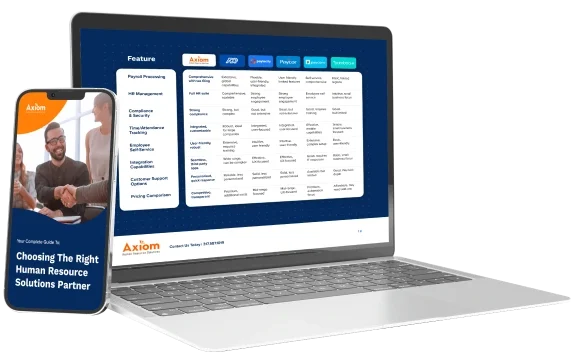
| Category | ✅ UKG Ready (via Axiom) | Paycor |
|---|---|---|
| Platform Heritage | 40+ years workforce management (Kronos + Ultimate) | Cloud-native, regional strength |
| Typical Customer Size | 100–2,000 employees | <500 employees (Tier 2 market) |
| Best Fit | Complex ops, regulated industries, multi-shift | Straightforward HR/payroll, local sales relationship |
| Implementation Approach | Thorough configuration, industry-specific | Fast timelines (may sacrifice depth) |
| Integration Capabilities | Open APIs, extensive marketplace | Limited API access reported |
| Complex Pay Rules | Shift diff, union rules, job costing — native | Workarounds required for advanced rules |
| Ongoing Support | Named Axiom team — knows your config | Call center, rotating reps |
| Price Transparency | Clear PEPM pricing | Fees may expand after signature |
*Based on publicly available market data and client feedback.
What “Good” Looks Like in HCM Platform Selection
Before diving into platform specifics, here’s what we look for in any successful HCM implementation. These are the benchmarks Axiom holds ourselves to — and the questions you should be asking any vendor or partner.
Configuration That Matches Operational Reality
Your pay rules, accrual policies, shift differentials, and compliance requirements should be configured to match how your organization actually operates. Additionally, systems should not force you into generic templates requiring workarounds.
Integration Without Friction
Your HCM system should connect cleanly to accounting, ERP, benefits carriers, and other business systems through proven APIs. Furthermore, you shouldn’t require manual file transfers or custom development for basic integrations.
Implementation That Builds Competence
Your team should finish implementation genuinely capable of operating the system. However, many teams end up just surface-familiar with basic functions while struggling with anything beyond routine tasks.
Support That Understands Context
When issues arise, you should reach people who understand your specific configuration and industry. In contrast, generalist support reading from scripts requires re-explaining your setup every call.
Scalability Without Re-platforming
Your system should handle your growth trajectory. For example, if you’re at 200 employees now but planning to reach 800, you shouldn’t need to migrate platforms midway through that journey.
UKG Ready: Strengths and Considerations
UKG Ready emerged from combining Kronos (workforce management leader) and Ultimate Software (HCM leader). Therefore, it brings together deep expertise in both domains.
Strengths
Configuration Depth for Complex Operations
UKG Ready offers extensive configuration options for pay rules, accruals, scheduling, and compliance requirements. Organizations with complex scenarios can configure the system to match actual practices. These scenarios include multiple pay rates, shift differentials, union rules, multi-state operations, and job costing.
Workforce Management Integration
Because UKG has roots in time and attendance and scheduling (Kronos heritage), these capabilities are deeply integrated rather than bolted on. For organizations where labor cost management and scheduling optimization matter significantly, this native integration provides measurable advantages. Learn more about time and labor management solutions.
Open API Architecture
UKG Ready provides extensive API access and a robust integration marketplace. Organizations with existing technology stacks can connect cleanly to accounting systems, ERP platforms, benefits carriers, and business intelligence tools. Furthermore, standard integrations don’t require custom development.
Industry-Specific Capabilities
UKG Ready includes functionality specifically designed for healthcare, manufacturing, construction, and other industries with complex workforce requirements. This includes credential tracking, certification management, and compliance features addressing real operational needs.
Proven Scalability
UKG Ready handles growth well. Organizations routinely scale from 50 to 2,000+ employees without platform constraints. As a result, the system is optimized for the complexity that accompanies growth.
Reporting Breadth
UKG Ready includes 500+ pre-built reports covering HR, payroll, time and attendance, and workforce analytics. For most standard reporting needs, organizations find what they need without building custom reports from scratch.
Considerations
Implementation Requires Expertise
The same configurability that makes UKG Ready powerful also makes implementation more involved. Therefore, organizations need either strong internal HRIS resources or a capable implementation partner like Axiom to fully leverage the platform.
Interface Prioritizes Capability Over Simplicity
The user interface is comprehensive and functional but not as immediately intuitive as some newer platforms. The learning curve is steeper. However, the depth of capability justifies the investment for organizations with complex requirements.
Paycor: Strengths and Considerations
Paycor has built its market position through regional sales strength, competitive pricing, and fast implementation timelines.
Strengths
Local Sales Presence
Paycor emphasizes local sales representatives who build direct relationships with customers. For organizations that value in-person sales interactions and regional presence, this approach appeals. Additionally, the local rep model creates personal touchpoints during the sales process.
Competitive Pricing
Paycor’s pricing structure is often competitive, particularly for smaller organizations in the mid-market segment. Organizations with straightforward requirements and budget sensitivity may find Paycor’s pricing attractive.
Fast Implementation Timelines
Paycor implementations typically move quickly—often 30-60 days. For organizations with straightforward requirements and urgency to launch, this speed provides value.
Unified Platform
Paycor offers a single-vendor platform covering HR, payroll, time and attendance, and benefits administration. As a result, organizations prefer working with one vendor rather than managing multiple point solutions.
Considerations
Implementation Speed vs Thoroughness
Industry feedback suggests Paycor implementations are often rushed to meet aggressive timelines. Fast implementations feel good initially. However, they can create configuration gaps that surface as organizations scale or encounter complex scenarios.
Thorough configuration takes time—shortcuts made during implementation often cost more to fix later. In fact, proper setup upfront prevents expensive corrections down the road.
Sales Representative Turnover
Organizations have reported high turnover among Paycor sales representatives. The local rep relationship that attracted customers during the sales process may not persist. Your primary contact may move to another company within 6-12 months. Consequently, when sales relationships don’t provide continuity, the perceived value of local presence diminishes.
Integration Limitations
Multiple organizations have noted that Paycor lacks comprehensive API access compared to platforms like UKG Ready. For businesses with existing technology stacks requiring clean integrations to accounting, ERP, or industry-specific software, limited API access creates friction. Furthermore, it may require manual workarounds or custom development for what should be standard integrations.
Flexibility Concerns at Scale
As organizations grow and complexity increases, some find Paycor’s flexibility constraints become more apparent. Organizations with complex pay rules, multiple locations, or industry-specific requirements sometimes discover problems. Configurations requiring workarounds in year one become significant operational friction by year three.
Common Mistakes When Evaluating UKG vs Paycor
Based on helping our clients through platform evaluations and migrations — including organizations that came to us after a painful experience with a rushed implementation — these are the most common mistakes we see in the UKG vs Paycor evaluation:
Mistake 1: Prioritizing Implementation Speed Over Quality
A 30-day implementation that leaves configuration gaps costs more long-term than a 60-day implementation done thoroughly. Fast timelines feel good during procurement. However, rushed implementations create compounding problems. Therefore, ask vendors: “What gets sacrificed to hit that timeline?”
Mistake 2: Assuming Sales Relationships Persist
If local sales relationships drive your decision, understand the stability of those relationships. Ask current customers: “Is your original sales rep still your contact?” High sales turnover means the relationship that attracted you may not be there when you need support.
Mistake 3: Not Testing Your Actual Integrations
Don’t just ask “Do you integrate with [system]?”—request a demonstration of the actual integration. Is it native API-based integration, or does it require manual file transfers? Additionally, will it handle your data volume? Test your actual integration requirements, not generic capabilities.
Mistake 4: Evaluating Based on Current State, Not Growth Trajectory
Choose platforms for where you’re going, not just where you are. For example, if you have 200 employees now but plan to reach 600 in three years, evaluate whether the platform is optimized for your future state—not just whether it can technically handle your current needs.
Mistake 5: Ignoring Implementation Partner Options
For platforms like UKG Ready, the implementation partner often determines success as much as the platform itself. Don’t just compare platform to platform. Instead, compare “Platform A implemented by Partner X” vs “Platform B implemented directly.” Implementation quality matters enormously.
The Integration Reality: UKG Ready vs Paycor API’s
Integration capabilities reveal themselves slowly—usually after purchase decisions are made. Therefore, this makes integration assessment critical during evaluation of UKG Ready vs Paycor evaluation. The UKG vs Paycor integration comparison often reveals the most significant operational differences:
UKG Ready provides extensive API access and a robust integration marketplace. Organizations routinely connect to accounting systems (QuickBooks, NetSuite, Sage), ERP platforms, benefits carriers, background check providers, and industry-specific software through proven, supported integrations. According to Gartner, API architecture and integration capabilities are critical factors in mid-market HCM selection. Additionally, the API documentation is comprehensive, and the partner ecosystem includes integration specialists for complex scenarios.
Paycor integration capabilities have received mixed feedback. Organizations have reported limited API access compared to competitors. This requires workarounds for integrations that should be straightforward. For businesses with existing technology stacks, limited integration capabilities can create ongoing friction and manual processes.
During evaluation, don’t accept generic “yes, we integrate with that” responses. Instead, request demonstrations of your actual integrations, review API documentation, and talk to current customers about their integration experience.
Decision Framework: UKG Ready vs Paycor
When evaluating UKG Ready vs Paycor options, use this decision framework to determine which platform best matches your operational needs. The UKG vs Paycor decision often comes down to:
UKG Ready (with a partner like Axiom HRS) fits if:
- You have 100+ employees with plans to grow significantly
- Your operations include shift work, multiple locations, or complex scheduling
- You operate in regulated industries (healthcare, manufacturing, construction)
- You have complex pay rules (shift differentials, union contracts, job costing, prevailing wage)
- Integration with existing business systems is critical
- You value thorough implementation over speed
- You want industry-specific configuration expertise
- Support team stability and tenure matter to you
Paycor fits if:
- Your payroll and HR needs are straightforward
- You’re in the <500 employee range with moderate growth plans
- Local sales relationships are important to your decision process
- Fast implementation is a priority over configuration depth
- Your integration requirements are minimal
- You don’t have complex scheduling, shift differentials, or multi-location coordination
- Price sensitivity is a primary driver
Further evaluation needed if:
- You’re between 150-400 employees and growing
- Your complexity is increasing but not yet extreme
- Integration requirements exist but aren’t yet critical
- You’re unsure whether your requirements are “typical” or “complex”
Where Axiom Human Resource Solutions Fits
Axiom Human Resource Solutions is a UKG Ready Preferred Partner and Authorized Reseller. We work with mid-market organizations—particularly in healthcare, manufacturing, and construction—that need more than a software platform.
For organizations comparing UKG Ready vs Paycor platforms, we help evaluate honestly based on operational requirements. Our experience with both UKG vs Paycor implementations and migrations gives us unique insight into when each platform fits best:
Industry-Specific Implementation
We configure UKG Ready based on how your operation actually works—not generic templates. For healthcare, that means credential tracking, shift differentials, and compliance reporting. For manufacturing, multi-shift scheduling and labor cost management. For construction, job costing and certified payroll. Learn more about our payroll services and HR outsourcing solutions.
Thorough Configuration Without Rush
We prioritize configuration quality over arbitrary speed. Our typical implementations take 60-90 days because we invest time in understanding your pay rules, testing scenarios, and training your team properly. Furthermore, shortcuts made during implementation cost more to fix than doing it right initially.
Team Stability and Tenure
Our team averages 8+ years on the UKG platform. When you have complex questions, you’re talking to someone who has likely solved similar problems before. Additionally, your primary contacts remain consistent throughout implementation and beyond.
Integration Expertise
We leverage UKG Ready’s open API architecture to create clean integrations with your existing business systems. Whether connecting to accounting software, ERP platforms, or industry-specific tools, we ensure data flows cleanly without manual workarounds.
Ongoing Partnership
We don’t disappear after go-live. Organizations change, regulations evolve, and your system needs to adapt. Therefore, Axiom provides ongoing optimization and support from people who know your specific configuration and operational context.
“Fast implementations feel good during the sales process, but thorough implementations create long-term value. We’ve helped dozens of organizations recover from rushed implementations that were technically complete but operationally broken. The gap between ‘it works’ and ‘it works well’ is configuration quality—and configuration quality requires time, expertise, and unwillingness to cut corners.”
— Andy Zelt, Founder & CEO, Axiom Human Resource Solutions

Frequently Asked Questions: UKG Ready vs Paycor Comparison
These are the most common questions organizations ask when comparing UKG Ready vs Paycor platforms:
What size company is UKG Ready best for?
UKG Ready typically fits mid-market organizations with 100-2,000 employees, particularly those with complex operational requirements. The platform scales well beyond that range. Organizations with straightforward requirements and fewer than 100 employees may find the platform more powerful than needed. However, UKG Ready excels for organizations with complexity—multiple pay rules, shift differentials, multi-state compliance, or industry-specific requirements.
Is Paycor good for complex payroll?
Paycor handles standard payroll complexity—multi-state tax compliance, basic shift differentials, and typical accrual policies. However, organizations with highly complex scenarios like multiple union contracts, intricate job costing, healthcare credential tracking, or manufacturing shift premiums sometimes find Paycor requires workarounds for situations UKG Ready handles natively. Therefore, evaluate your most complex scenarios specifically during demos.
How does pricing compare between UKG Ready and Paycor?
Both platforms have similar price ranges for mid-market organizations. However, total cost of ownership extends beyond subscription fees. Consider implementation quality, integration costs, training investment, ongoing optimization needs, and the cost of errors when systems aren’t configured correctly. Additionally, a lower subscription price with rushed implementation and limited integrations often costs more long-term than investing in thorough setup upfront.
Does Paycor work well for healthcare organizations?
Paycor serves some healthcare organizations successfully, particularly those with straightforward requirements. However, healthcare organizations with complex needs should evaluate carefully. These include credential tracking across multiple facilities, shift differentials for various roles, union environments, or compliance-heavy operations. Therefore, request demonstrations of your most complex healthcare scenarios, not generic capabilities. Learn more about healthcare payroll compliance.
How long does UKG Ready implementation take?
Through Axiom, typical implementations take 60-90 days, though complex multi-location or highly regulated organizations may require additional time. We prioritize thorough configuration over arbitrary speed. Additionally, rushed implementations create problems that cost more to fix than doing it right initially. Organizations with straightforward requirements and strong internal HRIS resources might complete faster.
Should we work with a UKG partner or go direct?
Organizations with complex requirements, limited internal HRIS expertise, or need for hands-on industry-specific support generally benefit from working with a partner like Axiom. Partners provide configuration knowledge, industry expertise, and dedicated relationships. According to SHRM, implementation partner selection significantly impacts HCM success rates. Organizations with strong internal HRIS teams and straightforward requirements may succeed going direct. Therefore, evaluate any option by asking about team tenure, industry experience, and implementation approach—not just price. Read our complete guide on UKG Partner vs Going Direct.
Can we switch from Paycor to UKG Ready?
Yes. Organizations migrate from Paycor to UKG Ready as their complexity increases or when they discover Paycor’s limitations don’t match their operational requirements. The process involves data extraction, mapping to UKG Ready’s structure, configuration aligned to your operations, comprehensive training, and thorough testing. Furthermore, most migrations complete within 60-90 days with proper planning and experienced implementation partners.
What if we already have UKG Ready but it’s not working well?
This is more common than organizations expect. Many implemented UKG Ready without adequate partner expertise or with configuration shortcuts during rushed implementations. Axiom offers optimization services to assess, reconfigure, and tune existing implementations. As a result, we often reveal capabilities organizations didn’t know they had and fix long-standing problems that seemed inherent to the platform but were actually configuration issues.
What are the main reasons organizations switch from Paycor to UKG Ready?
Common drivers include: integration limitations as technology stacks grow more complex, scalability concerns as employee count and operational complexity increase, need for deeper workforce management capabilities, and desire for more thorough implementation and ongoing support. Organizations often report that Paycor worked adequately when they were smaller and simpler. However, it became constraining as complexity increased.
How does support experience compare between Axiom and direct vendor support?
With Axiom, you work with a dedicated team averaging 8+ years on the UKG platform who knows your specific configuration and industry context. In contrast, with direct vendor support from any provider, experience depends on the representative assigned, their tenure, and their familiarity with your organization type. Therefore, ask any vendor—including us—about support team tenure, industry expertise, and relationship consistency before deciding. Team stability matters enormously for complex implementations.
Ready to Evaluate Your UKG Ready vs Paycor Options?
If you’re comparing UKG Ready vs Paycor or other HCM platforms, we’re happy to have a straightforward conversation about what your specific operational requirements mean for platform selection. Our UKG vs Paycor assessment process is completely objective and pressure-free.
We date you, not just sell you. At Axiom, we take time to understand your operation before we ever propose a solution. Call us for a real conversation about your requirements — no pitch deck, no obligation. If UKG Ready is the right fit, we’ll show you exactly how we’d implement it for your specific industry. If it’s not, we’ll tell you that too. Actions speak louder than words.
Keep Learning: Related Guides and Resources.
- UKG vs Paycor: Complete Comparison Blog
- UKG Ready vs Paylocity Comparison
- UKG Partner vs Going Direct Guide
- Healthcare Payroll Compliance Solutions
- Manufacturing HR & Payroll Solutions
- Payroll Services
- HR Outsourcing
The UKG Ready vs Paycor decision comes down to what happens after the contract is signed. In the UKG Ready vs Paycor comparison, Paycor competes well on user interface — but mid-market employers with complex payroll needs, union rules, or multi-state workforces consistently report that Paycor’s configuration depth falls short. UKG Ready vs Paycor: UKG wins on architecture, implementation quality, and the availability of Preferred Partners like Axiom who own your outcomes after go-live.
⚡ Axiom’s Verdict
For mid-market employers with complex hourly workforces — healthcare, manufacturing, construction — UKG Ready consistently outperforms Paycor where it counts: implementation depth, ongoing support, and compliance accuracy.
Paycor competes well on user interface and regional sales relationships. UKG Ready wins on architecture, scalability, and the partner ecosystem that keeps your system tuned after go-live. If your payroll involves shift differentials, multi-state compliance, or job costing — the choice is clear.
📖 Related Reading:UKG vs Paycor: How to Know It’s Time to Switch — Read: Signs It’s Time to Switch from Paycor to UKG →
Thinking about switching? Read our complete guide: How to Switch Payroll Providers: 7 Proven Steps