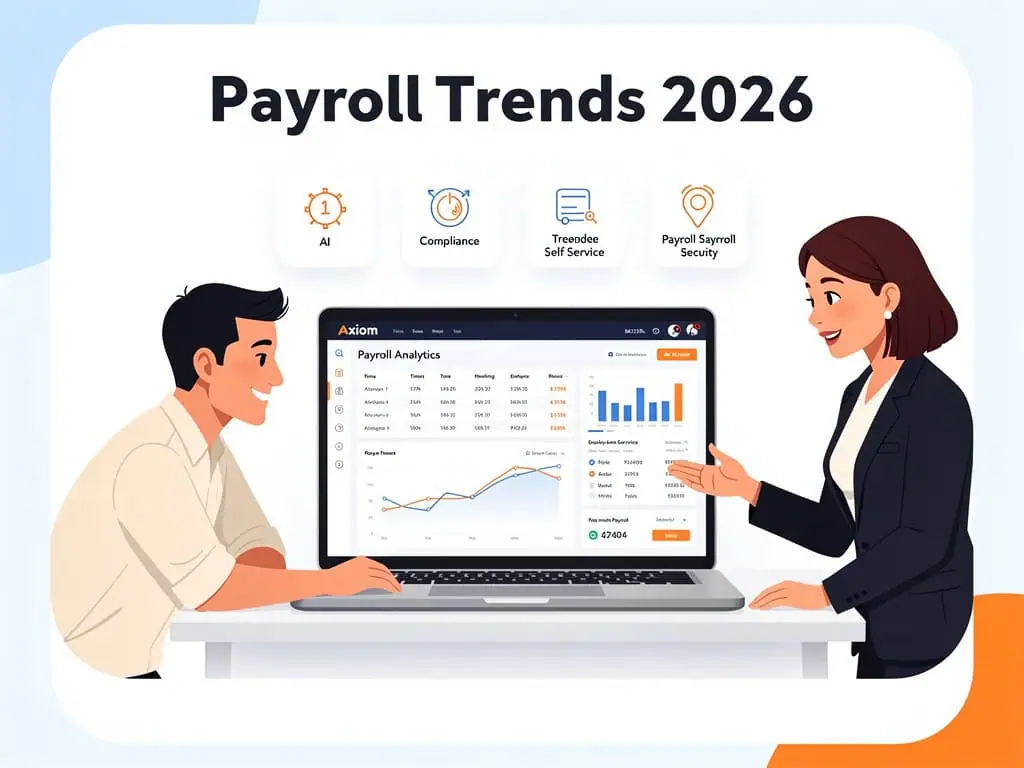
Payroll trends 2026 are not just about faster software.
This updated 2026 guide replaces our earlier payroll trends outlook and reflects what growing employers need to watch now.
They are about whether your business can keep payroll accurate while rules change, employees expect better access, managers need real-time labor data, and every platform is suddenly promising AI.
Here is the part most vendors will not say out loud: payroll technology is only as good as the setup behind it.
AI can flag an issue. It cannot magically understand your shift differentials, overtime rules, union setup, PTO policy, holiday schedule, job costing structure, or multi-state tax footprint unless the system is configured correctly.
That is the real payroll trend for 2026.
The companies that win will not be the ones chasing shiny features. They will be the ones building cleaner payroll operations, better data, tighter compliance, and stronger human oversight around the technology.
Direct Answer: The biggest payroll trends for 2026 are AI-assisted payroll, integrated payroll and workforce management, stronger compliance automation, real-time labor cost reporting, employee self-service, flexible pay expectations, payroll data security, and better implementation support. For mid-market employers, the practical goal is simple: reduce payroll errors, improve compliance visibility, and connect payroll with time, HR, benefits, and reporting on one accurately configured system.
Table of Contents
- AI Moves From Payroll Demo to Payroll Workflow
- Payroll Compliance Gets More Complicated
- Payroll and Workforce Management Keep Merging
- Real-Time Payroll Data Becomes a Leadership Tool
- Employee Self-Service Becomes the Front Door
- Flexible Pay Expectations Continue to Rise
- Payroll Data Security Becomes Non-Negotiable
- Implementation Quality Becomes the Differentiator
- How Axiom HRS Helps Growing Businesses Prepare
- Frequently Asked Questions
1. AI Moves From Payroll Demo to Payroll Workflow
AI in payroll is no longer a future concept. It is already showing up in payroll platforms, HCM systems, reporting tools, employee support, and compliance workflows.
That does not mean AI is ready to run payroll by itself.
Let me be direct. Payroll is one of the worst places in the company to confuse automation with ownership.
A good AI-assisted payroll process can help with:
- Payroll exception review, such as missing punches, unusual overtime, duplicate earnings, or unexpected deductions.
- Compliance prompts, such as reminders around tax updates, wage thresholds, benefit deductions, and filing deadlines.
- Employee questions, such as paycheck explanations, PTO balances, direct deposit updates, and W-2 access.
- Reporting support, such as summarizing payroll trends, labor costs, turnover patterns, and overtime exposure.
- Process documentation, such as turning payroll steps into checklists, SOPs, and training guides.
Here is the catch: AI needs clean data, accurate rules, and a payroll expert watching the outputs.
If your timekeeping setup is wrong, AI will help you process bad data faster. That is not progress. That is a compliance problem wearing a software badge.
Axiom POV: Every platform has AI now. The differentiator is the operator standing behind it. The tool is 20% of the win. The implementation and ongoing expertise is the other 80.
2. Payroll Compliance Gets More Complicated in 2026
Payroll compliance is getting harder because the rules are no longer just federal.
State and local wage rules, paid leave laws, overtime requirements, tax changes, benefit limits, pay transparency rules, and worker classification standards keep moving. That matters because payroll is where those rules become real.
The spreadsheet does not care whether your employee works in Indiana, Illinois, Ohio, Kentucky, Tennessee, or three states in the same quarter. Payroll does.
In 2026, employers need to pay closer attention to:
- Federal payroll tax updates, including wage bases and contribution limits.
- State and local minimum wage changes, especially for multi-state employers.
- Paid leave and sick leave rules, which often require payroll deductions, accrual tracking, or employer reporting.
- Overtime and exemption rules, including federal and state salary threshold differences.
- Independent contractor classification, especially for companies using 1099 workers, subcontractors, field labor, or project-based talent.
- Benefit deduction accuracy, including retirement contributions, catch-up contributions, HSA/FSA deductions, and employer match calculations.
The companies that struggle are usually not ignoring compliance. They are trying to manage it across too many disconnected systems.
One system has time. Another system has payroll. Another system has benefits. Another spreadsheet has accruals. Another person has the real answer in their head.
That works until it does not.
3. Payroll and Workforce Management Keep Merging
One of the biggest payroll trends for 2026 is the continued merging of payroll, timekeeping, scheduling, leave management, and workforce reporting.
That is not just a software preference. It is an operational necessity.
Payroll is downstream from workforce management. If schedules are wrong, punches are wrong, job codes are wrong, shift differentials are wrong, or PTO balances are wrong, payroll inherits the mess.
This is why growing businesses are moving away from disconnected tools and toward integrated HCM platforms where payroll and workforce management share the same employee record.
When payroll and workforce management are connected, companies get:
- Cleaner time-to-payroll workflows with fewer manual imports and exports.
- Better overtime visibility before payroll is finalized.
- More accurate labor costing by department, job, location, or shift.
- Fewer duplicate corrections between HR, payroll, and operations.
- Stronger compliance tracking across pay rules, breaks, leave, and accruals.
Here is what I have learned after years in payroll and HCM: payroll problems usually start before payroll.
They start in the schedule. They start in the time clock. They start in the policy setup. They start in the implementation.
Fix the upstream workflow and payroll gets cleaner.
4. Real-Time Payroll Data Becomes a Leadership Tool
Payroll used to be treated as a back-office process.
That thinking is outdated.
In 2026, payroll data is leadership data. It tells you where labor costs are moving, where overtime is climbing, where turnover is creating wage pressure, and where managers are losing control of scheduling.
But leadership cannot use payroll data if it arrives three weeks late and requires someone to reconcile four exports first.
Modern payroll reporting should help leaders answer questions like:
- Which locations are driving overtime?
- Which departments are over budget on labor?
- Where are shift differentials increasing payroll cost?
- Which managers are approving the most missed-punch corrections?
- How much did turnover cost us this quarter?
- Are benefit deductions, PTO accruals, and payroll taxes being handled correctly?
The math does not lie. If payroll data is delayed, leadership decisions are delayed.
That is why real-time reporting is becoming one of the most important payroll capabilities for growing businesses.
5. Employee Self-Service Becomes the Front Door
Employee self-service is no longer just a nice feature.
It is the front door for payroll communication.
Employees expect to access pay statements, tax forms, direct deposit information, PTO balances, benefits, schedules, and personal information without sending three emails and waiting for someone in payroll to respond.
That expectation is not unreasonable. It is how the rest of their life works.
Strong employee self-service reduces payroll noise by helping employees handle routine tasks themselves:
- Viewing pay statements.
- Updating direct deposit.
- Accessing W-2s and tax forms.
- Checking PTO balances.
- Requesting time off.
- Reviewing benefit deductions.
- Updating personal information.
- Submitting missing punch corrections.
But self-service only works when the underlying setup is right.
If employees log in and see bad balances, confusing deductions, missing documents, or outdated information, trust disappears fast.
Self-service is not just about access. It is about accuracy.
6. Flexible Pay Expectations Continue to Rise
Flexible pay will keep gaining attention in 2026, especially among hourly workforces.
Earned wage access, pay cards, digital pay options, and faster payment methods all speak to the same employee expectation: people want more control over how and when they receive earned wages.
That does not mean every business should rush into flexible pay without a plan.
Here is the play: evaluate flexible pay through payroll operations, compliance, employee experience, and cash flow.
Ask these questions before turning anything on:
- How does the solution calculate available earned wages?
- Does it rely on accurate timekeeping data?
- Who pays the fees?
- How are corrections handled?
- How does it affect garnishments, deductions, taxes, and final pay?
- What happens when time entries are edited after wages are accessed?
Flexible pay can be a useful retention tool.
But if the timekeeping and payroll foundation is weak, flexible pay becomes one more place where bad data creates bad outcomes.
7. Payroll Data Security Becomes Non-Negotiable
Payroll data is some of the most sensitive information in the business.
Names. Social Security numbers. Bank accounts. Wage history. Tax forms. Benefit deductions. Addresses. Dependent information. Direct deposit details.
If that data is exposed, the damage is not theoretical.
In 2026, payroll security needs to be treated as part of the payroll process, not as a separate IT checklist.
Businesses should expect stronger controls around:
- Multi-factor authentication for payroll administrators and employees.
- Role-based access so users only see what they need.
- Audit trails for pay changes, direct deposit updates, tax elections, and admin activity.
- Approval workflows for sensitive payroll changes.
- Data encryption for payroll and employee records.
- Vendor management for third parties handling payroll or employee data.
Payroll fraud often starts with one weak process.
A fake direct deposit change. A compromised admin login. A rushed approval. A terminated employee who still has access. A vendor account nobody reviewed.
The fix is not paranoia. The fix is disciplined payroll security.
8. Implementation Quality Becomes the Differentiator
This may be the most important payroll trend for 2026.
More platforms will have AI. More platforms will have dashboards. More platforms will have mobile apps. More platforms will claim automation.
Fine.
The real question is whether the system is implemented correctly.
A payroll platform has to reflect how the business actually works:
- Pay groups.
- Frequencies.
- Locations.
- Departments.
- Job codes.
- Shift differentials.
- Overtime rules.
- PTO policies.
- Holiday schedules.
- Benefit deductions.
- General ledger mapping.
- Tax setup.
- Security roles.
- Approval workflows.
That is not a feature list. That is the operating system of payroll.
If those pieces are wrong, payroll becomes a recurring cleanup project.
Here is what the sales rep will not tell you: the implementation determines whether the platform actually delivers the value promised in the demo.
That is why growing businesses need to evaluate both the software and the people standing behind it.
What Businesses Should Do Before Changing Payroll Systems in 2026
Before switching payroll systems or adding new payroll tools, run a practical audit.
Not a 90-page consulting exercise. A real operating review.
Review Payroll Error Patterns
Look at the last six to twelve months of payroll corrections. Group them by cause: timekeeping, tax setup, benefits, deductions, manager approvals, employee changes, or system configuration.
The pattern will tell you where the real problem lives.
Map Time-to-Payroll Workflow
Document every step from schedule creation to final payroll submission. If the process depends on spreadsheets, exports, email approvals, or tribal knowledge, that is where risk lives.
Check Compliance Exposure
Review state registrations, local taxes, overtime rules, wage rates, paid leave setup, garnishments, final pay rules, benefit deductions, and employee classifications.
Payroll compliance is not one setting. It is hundreds of small settings working together.
Evaluate Reporting Quality
Ask whether leadership can see labor costs, overtime, headcount, turnover, and payroll trends without waiting on manual reconciliation.
If reports disagree, the system is not telling the truth.
Test the Support Model
Ask who answers after go-live.
Not who sells the system. Not who runs the kickoff call. Who answers when payroll is due tomorrow and something is wrong?
That answer matters.
How Axiom HRS Helps Growing Businesses Prepare for 2026 Payroll
Axiom Human Resource Solutions helps growing employers improve payroll, HR, workforce management, benefits, and compliance operations through UKG Ready technology and hands-on support.
We work best with mid-market organizations that have outgrown basic payroll tools and need a more connected system.
That usually means employers with 50 to 2,000 employees, multi-location teams, hourly workforces, complex schedules, benefit deductions, overtime rules, or compliance requirements that no longer fit inside a spreadsheet.
Axiom helps businesses:
- Implement and configure UKG Ready.
- Connect payroll with time, HR, benefits, and workforce management.
- Reduce manual payroll work and duplicate data entry.
- Improve reporting on labor costs, overtime, and workforce trends.
- Support payroll and HR teams with named experts, not call center roulette.
- Build cleaner processes for compliance, employee self-service, and payroll operations.
Payroll is too important to run on hope, patchwork, and “we have always done it this way.”
The platform matters. The setup matters more. The people behind it matter most.
Frequently Asked Questions About Payroll Trends in 2026
What are the biggest payroll trends for 2026?
The biggest payroll trends for 2026 are AI-assisted payroll, payroll compliance automation, integrated payroll and workforce management, real-time labor cost reporting, employee self-service, flexible pay expectations, stronger payroll security, and better implementation support.
How is AI changing payroll in 2026?
AI is helping payroll teams identify exceptions, summarize payroll data, answer routine employee questions, and support compliance workflows. AI does not replace payroll expertise. It works best when the payroll system is accurately configured and reviewed by experienced operators.
Why should payroll and workforce management be connected?
Payroll depends on accurate time, scheduling, PTO, job codes, shift differentials, and manager approvals. When workforce management and payroll are connected on one system, employers reduce manual reconciliation, improve labor reporting, and lower the risk of payroll errors.
What payroll compliance issues should employers watch in 2026?
Employers should watch federal payroll tax updates, state and local wage laws, paid leave requirements, overtime exemption rules, independent contractor classification, benefit deduction accuracy, and employee data security. Multi-state employers should be especially careful because compliance obligations can vary by location.
When should a business replace its payroll system?
A business should consider replacing its payroll system when payroll errors become recurring, reports across systems do not match, HR and finance teams rely on manual reconciliation, employees cannot access basic payroll information, or compliance requirements have outgrown the current setup.
Is flexible pay right for every business?
No. Flexible pay can improve employee experience, especially for hourly workforces, but it requires accurate timekeeping, clear deduction handling, compliance review, and a strong payroll process. Employers should not add flexible pay on top of a weak payroll foundation.
About the Author
Andy Zelt is the Founder and CEO of Axiom Human Resource Solutions, a boutique UKG Ready implementation, HR outsourcing, payroll, and workforce management firm headquartered in Indianapolis, Indiana. Since founding Axiom in 2011, Andy has helped hundreds of mid-market employers improve payroll, HR, and compliance operations through practical technology, accurate configuration, and hands-on advisory support.
Andy has nearly 25 years of payroll and HR experience and specializes in helping organizations with 50 to 2,000 employees replace fragmented HR systems with integrated, accurately configured HCM platforms. His work focuses heavily on healthcare, manufacturing, construction, and other industries managing complex hourly workforces, shift differentials, multi-state compliance, and payroll accuracy challenges.
Connect with Andy on LinkedIn.
About Axiom Human Resource Solutions
Axiom Human Resource Solutions is a boutique UKG Ready Preferred Partner and authorized reseller headquartered in Indianapolis, Indiana. Founded in 2011, Axiom serves mid-market organizations with 50 to 2,000 employees across the United States.
Axiom specializes in payroll services, HR outsourcing, benefits administration, time and labor management, workforce management, HR compliance, and UKG Ready implementation. The company supports employers in healthcare, manufacturing, construction, and other industries with complex pay rules, shift differentials, multi-state compliance needs, and large hourly workforces.
Axiom’s mission is simple: We help you win with technology, backed by humans who care.
Visit axiomhrs.com or call 317-587-1019.