Most companies don't pick the wrong HR system. They pick a fine system the wrong way.
I've sat in a couple hundred of these evaluations since 2011, and the pattern is the same every time: a demo that looks great, a contract that gets signed, and a year later the system is a very expensive place to store PTO requests. The software rarely failed. The selection process did. Here's the process I'd run if I were sitting on your side of the table, including the numbers vendors would rather you not ask about.
The Short Answer
Choosing the right HR management system comes down to five steps: document your actual problems, shortlist three to five vendors that fit your size and industry, test with your own scenarios instead of the vendor's demo script, price the total cost including implementation, and check what happens after go-live. For mid-market companies, plan on $8 to $25 per employee per month for software and 8 to 16 weeks for implementation.
HR Management Systems by the Numbers
- Only 43% of HR professionals rate their HR technology as effective (SHRM, 2025).
- The average HRIS is actively used by just 32% of employees (Gartner).
- 56% of organizations still move HR data between systems manually (Sapient Insights).
- Mid-market HR software runs $8 to $25 PEPM plus implementation (Zimyo, 2026).
- Average cost-per-hire is $4,700 with a 44-day time-to-fill (SHRM).
Table of Contents
What is an HRMS, and what should it replace?
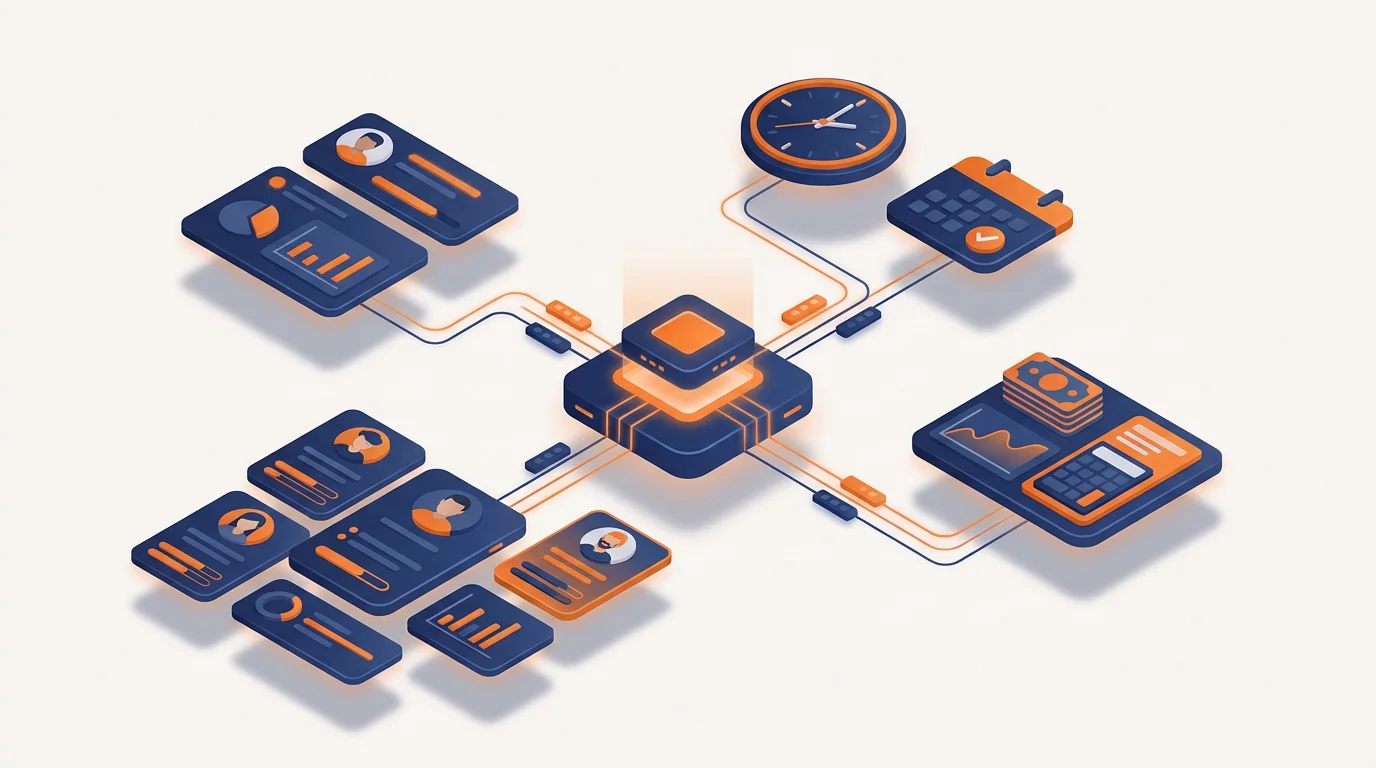
An HR management system (HRMS) runs the employee lifecycle in one place: onboarding, payroll, benefits, time, performance, and reporting. Think of it as the system of record for everything about your people.
The word that matters in that sentence is one. The average organization ran 26 separate HR modules in 2024, and 56% still move data between systems by manual entry or file uploads, per Sapient Insights. Every one of those handoffs is a place where an address change gets lost or a pay rate goes stale.
So the real question isn't "which HRMS has the most features?" It's "which one lets me retire the spreadsheet farm?" A proper HR management system should replace your standalone time tracker, your paper onboarding packets, and the monthly ritual of reconciling HR data against payroll data.
Why do so many HRMS purchases go sideways?
The numbers here are ugly. Only 43% of HR professionals rate their organization's HR technology as effective, per SHRM's 2025 State of the Workplace. And Gartner survey data shows the average HRIS is actively used by only 32% of employees.
That's not a software problem. That's a selection and implementation problem.
The pattern I see: the committee evaluates features, not workflows. Nobody tests the messy stuff, like a mid-year benefits change or a retro pay correction. The demo is driven by the vendor's script instead of your scenarios. And the implementation gets handed to whoever had the least on their plate that quarter.
Every step below exists to prevent one of those failures.
The 5 steps to choosing right
- Document problems, not wishes: List the ten things that burn the most hours today. Those are your requirements. Feature wishlists come after.
- Shortlist by size and industry: Three to five vendors that actually serve your headcount and your industry's pay complexity. A system built for 20-person offices will not survive shift differentials.
- Test with your scenarios: Bring your ugliest real cases to the demo: the multi-state hire, the retro adjustment, the mid-year benefits change. Watch them handled live, not in slides.
- Price the total, not the sticker: Software PEPM plus implementation plus the modules you'll add in year two. Get it in writing.
- Check what happens after go-live: Who answers when payroll breaks on a Friday? A named team or a ticket queue? This one answer predicts your next three years.
What does an HRMS actually cost in 2026?
For growing companies between 50 and 250 employees, market pricing runs $8 to $25 per employee per month for the software, with implementation between $3,000 and $15,000, per Zimyo's 2026 market survey. Larger headcounts negotiate lower per-employee rates but bigger implementation projects.
The math doesn't lie: turnover is what makes the system pay for itself. SHRM benchmarks the average cost-per-hire at $4,700 with a 44-day time-to-fill. An HRMS that shaves even a week off hiring and keeps a handful of people from quitting over payroll errors covers its own bill.
Watch for the costs that don't appear on the quote: per-module add-ons, integration fees for the systems the HRMS doesn't replace, and services hours for every configuration change. Our pricing page shows how we package it, because we'd rather publish the numbers than make you sit through a discovery call to get them.
Want a real quote instead of a range? Tell us your headcount and industry. You'll get actual numbers, not a brochure.
Get My NumbersWhich questions should you ask every vendor?
Six questions, and the answers tell you more than any feature matrix.
What does implementation look like week by week, and who does the work? What training do managers get, not just HR? Which of our current systems does this replace entirely, and which does it merely connect to? What are the security standards and where does our data live? What does support look like after go-live, with names? And what will this cost in year two, when we add the modules you know we'll add?
A vendor who answers all six crisply has done this for companies like yours. A vendor who routes half of them to "your account executive will follow up" is telling you what support will feel like later.
When does a partner beat a vendor?
Buying an HRMS direct gets you the software and a queue. Buying through a partner gets you the software plus the people who configure it around your operation.
We're a UKG Ready Preferred Partner, and here's the honest version of what that means: same platform you'd get from the mothership, but implementation, training, and support come from a team of 24 in Indianapolis that knows your account by name. For mid-market companies in healthcare, manufacturing, and construction, where the pay rules are the hard part, that difference shows up in every payroll run.
If you're comparing platforms right now, our take on HCM vs HRMS terminology will save you from paying for a label instead of a capability.
Andy's take
Ask every vendor for two references at your headcount in your industry, then actually call them. Ask one question: what do you wish you'd known before go-live? You'll learn more in two calls than in five demos.
Want help choosing without the sales circus?
Bring us your shortlist and your ugliest payroll scenario. We'll tell you what fits, including when the answer isn't us.
- 571 clients
- Since 2011
- UKG Ready Preferred Partner
- 90-day satisfaction guarantee
Frequently Asked Questions About HR Management Systems
How much does an HR management system cost for a mid-market company?
Market pricing for 50 to 250 employee companies runs $8 to $25 per employee per month, with implementation between $3,000 and $15,000. The number that matters is total cost over three years including add-on modules, integrations, and services hours.
How long does HRMS implementation take?
For mid-market companies, plan on 8 to 16 weeks depending on modules, data cleanliness, and pay rule complexity. The timeline is driven by decisions, not software: who approves what, which workflows apply to which roles.
What is the difference between an HRMS and an HCM?
Mostly marketing. HRMS, HRIS, and HCM all describe platforms that manage the employee lifecycle. Judge the capability list against your problems, not the acronym on the brochure.
Should we buy an HRMS directly or through a partner?
The software is identical either way. The difference is implementation and support. A partner configures the system around your operation and gives you named people to call, which matters most when your pay rules are complex.
External sources referenced: SHRM, Gartner, Sapient Insights Group, Zimyo
About the Author
Andy Zelt is the Founder and CEO of Axiom Human Resource Solutions, a boutique HR outsourcing and UKG Ready partner headquartered in Indianapolis, Indiana. Andy has spent nearly 25 years in payroll, HR, and human capital management, helping organizations clean up payroll operations, improve HR processes, and build better workforce systems.
Andy specializes in helping organizations with 50 to 2,000 employees replace fragmented HR systems with integrated, accurately configured HCM platforms, particularly those in healthcare, manufacturing, construction, and long-term care.
Connect with Andy on LinkedIn.
About Axiom Human Resource Solutions
Axiom Human Resource Solutions is a boutique HR outsourcing, payroll services, and UKG Ready support firm headquartered in Indianapolis, Indiana. Axiom helps growing businesses manage payroll, HR administration, benefits, time and labor, compliance support, and workforce technology with dedicated, named experts instead of call centers.
Visit axiomhrs.com or call 317-587-1019.